🔥 The New Environment: Speed, Pressure, and Endless Expectations
For decades, logistics was treated as a cost center: transportation, warehousing, deliveries, and issue resolution.
Today, in a global environment marked by constant disruption, service pressure, and rising expectations, logistics has evolved from an operational support function into a strategic differentiator.
The question is no longer “How much does it cost to move goods?” — the real question is: “How much value does a company lose every day by lacking control, visibility, and logistics predictability?”
We live in an era where customers expect the same experience in B2B as they do in their personal lives: full visibility, on-time deliveries, proactive communication, certainty, and predictability.
At the same time, supply chains face global volatility, constant disruptions, rising costs, pressure for efficiency, and international competition. In this context, logistics is no longer just operations — it’s strategy.
Many companies still operate with fragmented processes: calls to carriers, manual emails, multiple portals, spreadsheets as control systems, and delayed or incomplete information.
- Delays not detected in time.
- Reactive decision-making (expedites, urgent replacements).
- Increased operational workload for internal teams.
- OTIF penalties.
- Loss of customer trust.
Lack of visibility creates instability and additional costs that rarely appear clearly in budgets — but do show up in results.
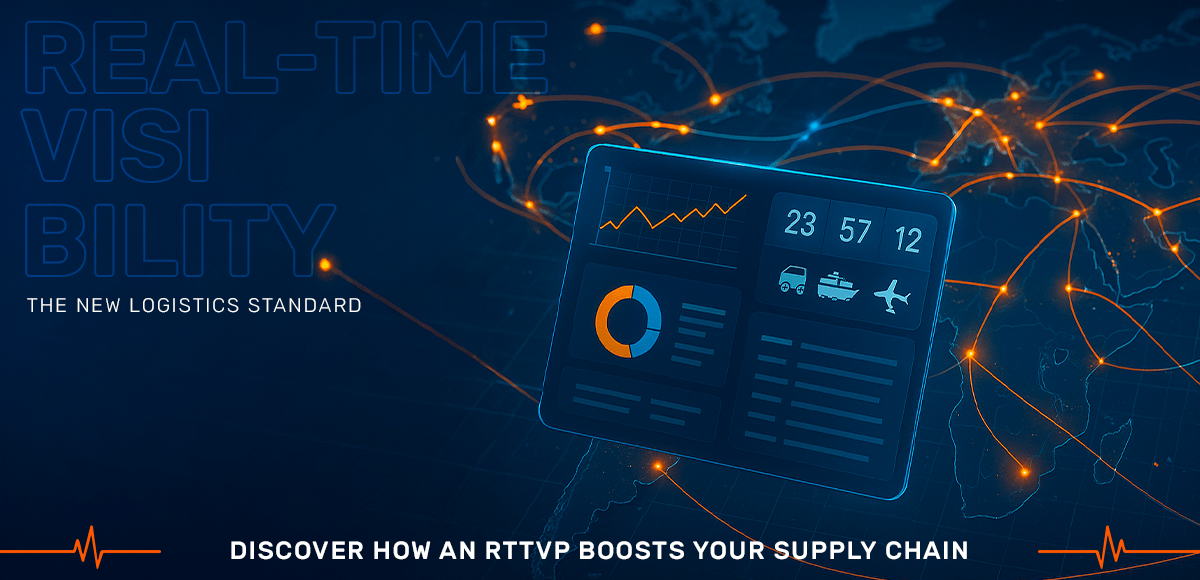
- Real-time location.
- Predictive ETA.
- Proactive alerts.
- Multimodal monitoring.
- Collaboration among stakeholders (shipper, carrier, consignee, 3PL).
This enables a critical shift: from reacting to anticipating.
✨ Let’s Talk About Measurable Benefits
Companies that adopt real-time tracking report up to a 25% increase in on-time delivery — directly supporting contract compliance, reducing incidents, and improving customer satisfaction and retention.
2. Reduction in OTIF penalties
Penalties for late or incomplete deliveries are a growing trend. With an RTTVP, delays can be anticipated, communication becomes proactive, and evidence is documented to challenge penalties — resulting in a direct reduction in sanction-related costs.
3. Lower costs from expedited shipments
Lack of certainty leads to costly decisions such as expedites, accelerated replacements, and preventive orders. With visibility and reliable ETAs, many companies significantly reduce spending on logistics emergencies.
4. Fewer detention times and delays
Idle time in yards, distribution centers, and delivery points represents millions in operational waste. Gartner research has found that:
- Driver detention can be reduced by up to 35%.
- Demurrage charges can decrease by up to 60%.
These improvements boost fleet productivity, increase available capacity, and improve efficiency at docks and warehouses.
5. Reduced internal operational hours
An RTTVP reduces manual work in tracking and follow-up activities, verification calls, ETA inquiries, and incident management — freeing up resources for strategic tasks and lowering indirect labor costs.
👏🏼 Logistics as a True Competitive Advantage
The benefits go beyond cost savings. Logistics visibility directly impacts growth by enabling:
- Higher customer satisfaction.
- A better service experience.
- Competitive differentiation.
- International expansion capabilities.
Logistics has evolved from an operational area into a strategic function with direct impact on margins, service, efficiency, collaboration, and growth.
Companies that invest in real-time visibility don’t just reduce costs — they build smarter, safer, and more competitive supply chains.
👉🏼 At Recurso Confiable, we developed RC Control Track, an RTTVP built to global standards, connecting multiple data sources into a single, reliable platform that turns visibility into strategic decision-making.
Ready to transform your logistics?
Schedule a personalized Control Track demo and see how we can help you overcome your logistics challenges.