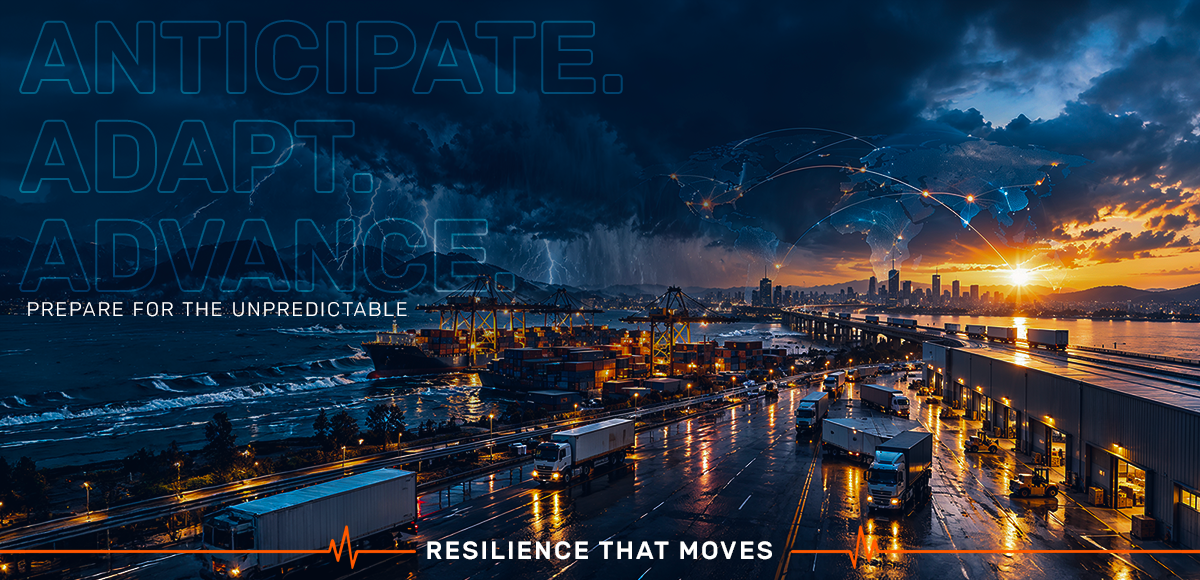
🌊 What No One Can Predict… But Everyone Must Be Ready to Face
A key supplier going bankrupt overnight, a weather event forcing a highway closure, a geopolitical crisis disrupting the supply of a critical input, a port strike freezing thousands of containers, a pandemic completely rewriting the rules of the global game.
None of these scenarios is improbable. In fact, all of them have happened, and they are likely to happen again — though not in exactly the same way, at the same time, or with the same impact — and that is precisely what makes logistics resilience so difficult to build: it is not about preparing for one specific scenario; it is about preparing for what you cannot predict.
🔍 What Is Logistics Resilience?
Three words deserve special attention: absorb, adapt, and recover. They are the difference between an operation that breaks under adversity and one that comes out stronger.
📉 The Cost of Logistics Fragility
During the disruption:
After the disruption:
In the long term:
🏗️ Four Pillars of a Resilient Logistics Operation
1. Full, Real-Time Visibility
You cannot manage what you cannot see, and you cannot adapt to a disruption if you learn about it when it is already too late to react. Real-time visibility into every shipment, every route, every supplier, and every node in the chain is the starting point of any resilience strategy. Not as a technological “nice to have,” but as a fundamental operational capability without which everything else is flying blind. When a disruption occurs, the first competitive advantage is knowing before everyone else: knowing there is a problem on the route before it affects the delivery, knowing a supplier is in trouble before it impacts production, knowing there are adverse weather conditions before the truck departs or while it is already on route. So visibility does not eliminate disruptions; it turns them into actionable information before they become crises.
2. Anticipation, Not Just Reaction
There is an enormous difference between an operation that reacts to disruptions and one that anticipates them: the first arrives late, while the second has time to prepare. Anticipation is built on historical data, predictive models, and continuous monitoring of risk signals to reduce the radius of surprise and widen the response window. For example, a predictive ETA that detects a potential delay two hours in advance is not the same as a delay alert that arrives when the shipment is already 45 minutes outside its window. Time is the most valuable resource in exception management.
3. Clear Exception-Response Processes
Technology can detect a disruption in seconds, true, but if there is no clear process defining who responds, how they respond, and with what tools, detection speed does not translate into resolution speed. The most resilient operations have response playbooks for the most likely risk scenarios; these processes are not improvised in the middle of a crisis. They are designed in advance and practiced beforehand.
4. An Organizational Culture Built for Adaptability
This is the most underestimated pillar and perhaps the most decisive. Resilience does not live in systems; it lives in the people who operate them. A team that knows how to act under pressure, has the authority to make decisions when it matters most, shares information instead of guarding it, and sees every disruption as a learning opportunity is a resilient team. Technology amplifies the resilience of a capable team, but it can never make up for the absence of one.
🧭 The Starting Point: Know Where You Are Vulnerable
What you cannot predict, you can prepare to face, and what you can see in advance, you can turn into an advantage.
How much are you losing today in your logistics operations?
Transform scattered data into real-time decisions with end-to-end visibility and predictive operations.