🚨The Problem No Logistics Operation Can Afford to Ignore
According to the Asociación Nacional de Empresas de Rastreo y Protección Vehicular (ANERPV), 4,941 cargo theft incidents were reported in Mexico in the first quarter of 2025 alone — an average of 55 thefts per day. 81% of those events involved violence, and 80% occurred on weekdays during nighttime hours, when visibility and surveillance drop significantly. Annual losses exceed 7 billion pesos, not counting the indirect impact on insurance premiums, customer penalties, and reputational damage. And that’s only what gets reported — the dark figure of theft (incidents never reported due to distrust, time constraints, or complex processes) pushes that number significantly higher.
The first step in protecting a logistics operation is understanding that security isn’t an insurance issue. It’s an operational intelligence issue.
🗺️Mapping the Risk: Where and How It Happens
According to ANERPV, the highest-risk zones are the State of Mexico, Puebla, and Guanajuato — the three states with the highest concentration of incidents nationwide. The highways with the highest incidence are México-Querétaro, Puebla-Veracruz, and México-Saltillo. A critical operational insight from ANERPV: criminal groups have begun shifting their operating routes in response to National Guard federal enforcement — meaning incidents are migrating to new zones previously considered safe. This is a dynamic reality: patterns shift, hotspots move, and a route that was safe six months ago may not be safe today.
The most common methods include:
- In-transit theft: the vehicle is intercepted on the highway, frequently on low-traffic stretches or during nighttime hours.
- Theft at origin or destination: during waits at yards, distribution centers, or loading/unloading points, where detention time is longer and surveillance is lighter.
- “Ant theft” (partial pilferage): partial removal of cargo during transit, difficult to detect without precise control over inventory in motion.
- Internal collusion: one of the most sensitive and frequent factors, where knowledge of routes, cargo, and schedules facilitates the crime.
What these methods have in common is that all of them are enabled by a lack of real-time visibility. When no one knows exactly where a vehicle is, how long it’s been stopped, whether it deviated from its route, or whether it’s responding to communications, the window of opportunity for theft widens exponentially.
🔒Visibility as the First Line of Defense
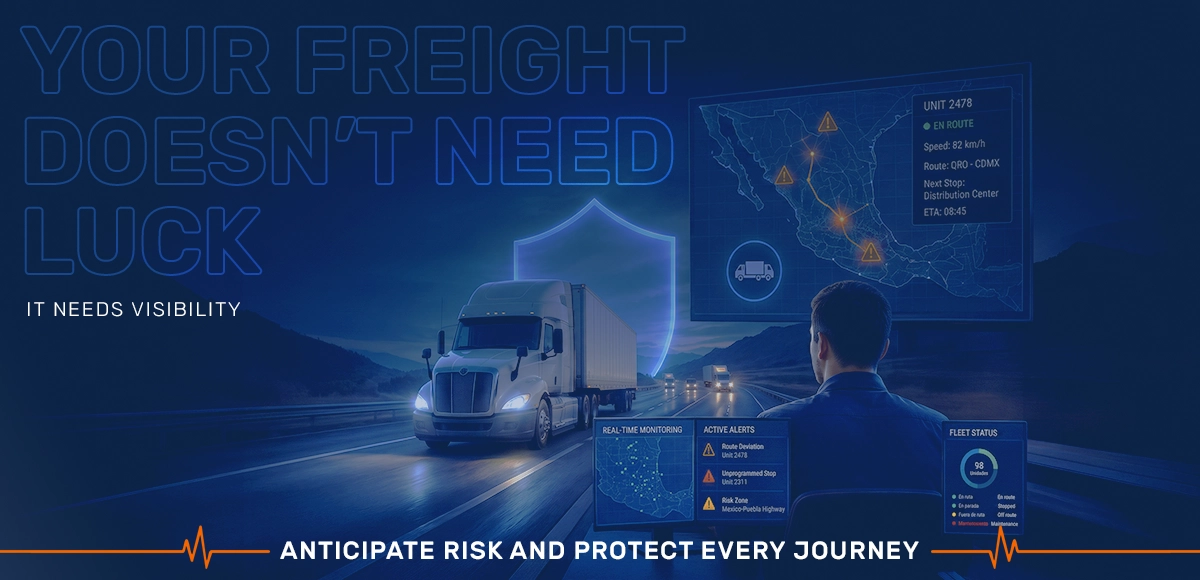
Real-time visibility changes the paradigm: from reacting to preventing. An RTTVP (Real-Time Transportation Visibility Platform) acts as a digital nervous system across the entire logistics operation, generating real-time security intelligence that makes it possible to anticipate, detect, and respond to risk situations before they turn into losses.
How does it do this, concretely?
2. Geofences and risk-zone alerts. High-incidence geographic zones can be defined so the system automatically raises the monitoring level, increases the frequency of position updates, and activates specific response protocols. A unit entering a critical zone doesn’t go unnoticed.
3. Detention time control. Time stopped at an unauthorized point is one of the clearest risk indicators. The platform measures and alerts on stops outside scheduled points, enabling action within minutes, not hours.
4. Complete trip traceability. Every event of the trip is logged: departure time, route taken, where it stopped, how long it took. That traceability has dual value — as a preventive tool, and as documented evidence in case of an incident or claim.
5. Direct communication with the driver. Visibility isn’t just about seeing — it’s about connecting. A robust system enables direct, verifiable communication with the driver, position and status confirmation, and response protocols for emergency situations.
📉The Real Cost of Theft: Beyond the Lost Cargo
Cost concept
Cargo value
Insurance deductibles
Claim management time
Urgent replacement
Customer penalties
Reputational damage
Higher insurance premiums
Impact on the team
Description
🧠Route Intelligence: The Next Level of Logistics Security
This means:
- Dynamic routing that avoids zones of currently active high incidence.
- Optimized schedules that reduce exposure during higher-risk time windows.
- Pattern analysis that identifies which routes, schedules, and cargo types have the highest historical incidence.
- Alerts powered by sector intelligence, integrating external, real-time security condition data.
The difference between a company that loses cargo recurrently and one that consistently reduces its loss rate isn’t luck. It’s the level of operational intelligence behind how it manages its routes and its risks.
🤝🏻Logistics Security: A Shared Responsibility
That means real-time visibility shouldn’t exist only in the transportation link — it needs to run across the entire chain: who loaded it, what was loaded, when it departed, who received it, and in what condition. Full traceability is the only way to manage responsibility clearly and protect every party involved in the event of an incident.
A visibility platform that connects every participant in the operation — shipper, carrier, receiver, control tower — is far more powerful than isolated security systems at each individual link.
✅What a Secure Operation Needs Today
A modern logistics security strategy should include:
- Real-time visibility over every unit, at all times.
- Automatic alerts for anomalous behavior or unscheduled stops.
- Active geofences in known risk zones.
- Complete, documented traceability of every trip.
- Clear response protocols activated directly from the platform.
- Pattern analysis to support preventive — not just reactive — decisions.
Cargo theft in Mexico isn’t going away in the short term. But the ability to anticipate it, detect it in time, and reduce its impact is fully within reach for any operation willing to take logistics security seriously.
Visibility doesn’t solve everything. But without visibility, nothing can be solved.
Ready to transform your logistics?
Schedule a personalized Control Track demo and see how we can help you overcome your logistics challenges.